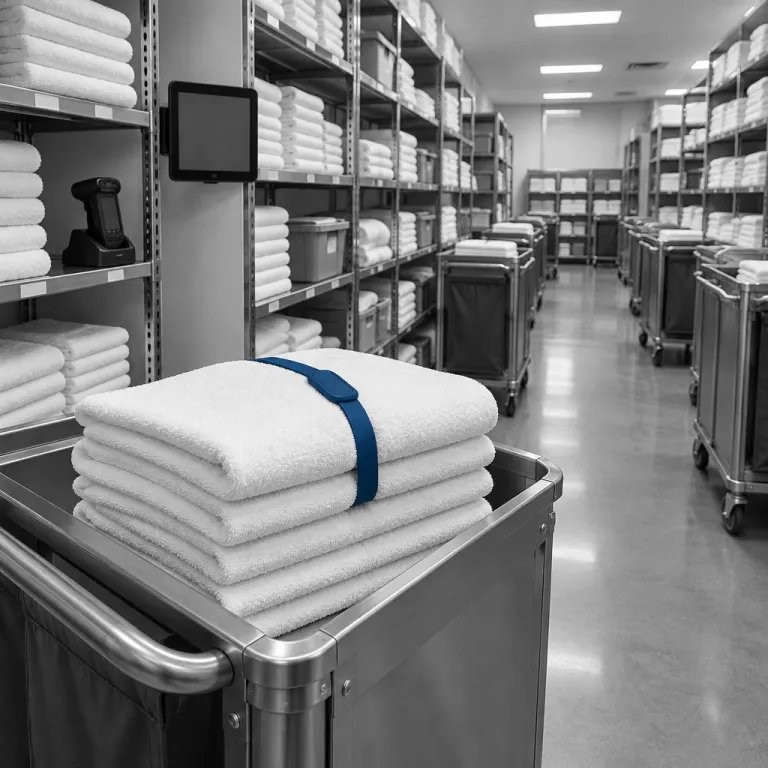
From linen room to boardroom: why towel tracking has become strategic
Executive summary. In modern hospitality, towel tracking has shifted from a back-office chore to a strategic capability. By tagging pool towels and other textiles with an RFID chip or similar identifier, hotels, resorts and mixed hospitality–medical complexes gain real-time visibility on towel circulation, towel losses, laundry cost and sustainability performance. This article explains how a towel tracker affects guest experience, front desk and pool deck operations, external laundry contracts, public policy and institutional investment decisions, drawing on industry benchmarks and indicative figures from European laundry associations and supplier case studies.
From linen room to boardroom: why towel tracking has become strategic
Across the hospitality ecosystem, the humble towel now sits at the crossroads of guest experience and asset protection. When thousands of towels circulate daily between pool, spa, fitness and laundry, a reliable towel tracker becomes a strategic tool rather than a back-office gadget. For public institutions and investors, the way resorts and urban hotels manage pool towels increasingly signals operational maturity, cost discipline and attention to environmental impact.
Large resorts typically handle several pool towels per occupied room, which multiplies the risk of towel losses and unplanned replacement cost across the season. Without a digital towel tracker, front desk and housekeeping staff rely on manual counts, paper logs and visual checks on the pool deck, which rarely align with real laundry data. This gap fuels disputes with guests about towel return, inflates linen budgets and complicates sustainability reporting for institutional stakeholders who monitor water, energy and textile waste.
Hotel groups that deploy an integrated towel tracker link each towel to an RFID chip or similar identifier, connecting the linen life cycle to property management and inventory systems. Every movement of towels guests use — from cabinet to pool, from pool deck to laundry, from laundry back to room or spa — becomes a data point for management. For tourism clusters and professional federations, these datasets help benchmark practices, support training for staff and inform public policy on water, energy and textile waste across destinations.
Stakeholders, standards and networks around smart towel ecosystems
The rise of the connected towel tracker is reshaping relationships between hotels, external laundry partners and technology providers. When each towel carries an RFID chip, the laundry contract shifts from simple kilo-based pricing to performance-based agreements that track losses, damage and life towel duration. This creates new negotiation levers for management and for institutional investors who scrutinise long-term operating cost, risk exposure and compliance with sustainability targets.
Professional federations and tourism clusters can play a central role by defining shared standards for pool towels identification, data formats and privacy rules for each guest’s swipe interaction. A member of a hotel network who uses a loyalty card at the front desk to receive guest towels should benefit from the same clarity on towel return conditions across properties. Networks that already coordinate digital distribution, such as those analysed in the context of how a specialised agency fits into the hospitality ecosystem, are well placed to extend their role to operational technologies like towel tracking.
Public institutions concerned with water consumption, textile waste and labour conditions in laundry operations gain new visibility when a towel tracker is deployed at scale. Aggregated data on towels guests use at the pool, in fitness areas or in medical spa facilities can inform subsidies, training programmes and environmental labelling schemes. For medical establishments that share infrastructure with resorts, the same RFID chip technology used for a life towel can also secure medical scrub circulation, reducing theft, cross-contamination risks and unplanned textile write-offs.
Operational flows: from front desk to pool deck and back to laundry
On the ground, the towel tracker touches almost every operational department, from the front desk to the back-of-house laundry. At check-in, staff can link a guest profile or room card to a defined number of pool towels, recording each guest’s swipe when towels are issued or when return towels are scanned. This simple gesture at the front desk transforms a chaotic process into a traceable transaction that protects both guests and staff while clarifying responsibility for towel return.
On the pool deck, a dedicated cabinet equipped with RFID readers can automate towel return, freeing the team from manual counting during peak hours. Guest towels are dropped into the cabinet, the tracker records the towels’ return in real time and the system updates the room or member account, which reduces disputes and queues at the desk. In fitness areas, where towels guests use are smaller and turn faster, the same infrastructure can monitor usage peaks and optimise deliveries from laundry so that clean towels are always available.
Once towels leave the property, the external laundry scans each towel again, closing the loop between pool, room, spa and medical zones. Management teams can then compare the number of towels guests received with the number that reached laundry, isolating true towel losses from simple delays in return. For investors and tourism clusters, these reconciled flows provide hard data on cost per life towel, staff productivity and the impact of theft prevention policies, which can be validated through vendor case studies and audited laundry reports or, where such documentation is not available, through clearly labelled internal estimates.
Financial, environmental and risk impacts for institutional stakeholders
For institutional investors, the business case for a towel tracker rests on measurable reductions in towel losses and operating cost. Properties that introduce RFID chip based tracking often report double-digit decreases in replacement purchases, especially for pool towels that previously disappeared at high rates. For example, a 300-room resort that initially lost around 15% of its pool towels annually could, based on figures shared by European laundry groups, cut unexplained losses by roughly one third and save tens of thousands of euros per year in linen purchases and associated laundry cost.
The environmental dimension matters equally for public institutions and professional federations that promote responsible tourism. Fewer lost towels mean fewer emergency orders, less textile waste and more predictable laundry volumes, which translate into lower water and energy consumption per occupied room. Resorts that operate medical spa facilities or fitness clubs can also separate data for medical scrub items, ensuring that hygiene-critical textiles follow stricter cycles without inflating the footprint of standard guest towels or obscuring sustainability metrics.
Risk management extends beyond theft and cost control to liability and health protection. A robust towel tracker helps document cleaning cycles for towels guests use in sensitive areas such as medical treatment rooms, children’s pools or high-intensity fitness studios. In the context of AI-driven revenue and distribution tools, such as those analysed in agentic hotel booking and AI mediated distribution, this operational data can also feed into dynamic pricing models that reflect real service usage while remaining auditable for regulators and institutional partners.
Governance, data sharing and ecosystem level coordination
As towel tracker deployments scale across hotel groups and mixed-use resorts, governance questions become central for public institutions and tourism clusters. Who owns the data on guest towel usage, and how can it be shared between management, laundry partners and public authorities without compromising privacy? Clear answers are needed before RFID chip based systems become the norm across pools, fitness centres and medical spa facilities, especially when member programmes and loyalty cards are involved.
Professional federations can facilitate common frameworks for data retention, anonymisation and interoperability between different tracker vendors. When a member property changes laundry provider or upgrades its cabinet hardware, historical data on towel return and towel losses should remain accessible for benchmarking and regulatory reporting. Shared guidelines also help front desk and pool deck staff explain to guests why their card or wristband is used for swipe operations linked to towels, reinforcing trust and aligning with data protection rules.
At destination level, tourism clusters can aggregate anonymised indicators on towel circulation to support sustainability labels and funding decisions. Public institutions may, for example, link grants for pool renovations to proven reductions in laundry-related water consumption, measured through towel tracker data and verified by independent auditors. In mixed hospitality medical complexes, joint governance committees can oversee both guest towels and medical scrub tracking, ensuring that operational efficiencies never compromise clinical standards or staff safety.
Implementation roadmaps and policy levers for the wider ecosystem
For many public institutions and investors, the key question is how to scale towel tracker adoption beyond a few flagship resorts. A pragmatic roadmap starts with high-impact zones such as pool and fitness areas, where guest towel turnover and theft risk are highest. Management can then extend RFID chip tagging to room towels, spa linens and medical scrub items once processes at the front desk and laundry are stabilised and early results have been documented in internal case studies.
Financing models also evolve as networks mature, with some hotel groups integrating towel tracking into broader digital transformation programmes. In such cases, the same virtual card and automated reconciliation tools that streamline supplier payments, as analysed in studies on B2B virtual cards in hospitality, can be aligned with linen and laundry contracts. This integrated approach allows investors to track the full cost of a life towel, from purchase and tagging to washing, storage in cabinet units and final disposal, with clear accountability for each stage.
Public policy can accelerate adoption through targeted incentives, technical guidelines and recognition programmes for best-in-class towel management. Tourism clusters might, for instance, support pilot projects that connect towel tracker data with destination-wide sustainability dashboards, highlighting reductions in towel losses and theft. When front desk teams, pool deck staff, laundry partners and medical facility managers all operate within a shared framework, the towel becomes a visible symbol of a more intelligent and accountable hospitality ecosystem.
Key figures on towel tracking in hospitality
- Industry studies from major linen suppliers report that hotels without any towel tracker can lose between 10% and 20% of their pool towels inventory annually, mainly through theft and non-returned items, with figures echoed in European laundry association reports and internal audits.
- RFID chip based systems typically reduce unexplained towel losses by 30% to 50% within the first full operating cycle, according to data shared by European laundry groups working with large resorts and confirmed in vendor case studies and pilot project evaluations.
- Water and energy savings linked to better towel management can reach 5% to 10% of total laundry consumption, when properties align towel tracker data with optimised washing loads and reduced emergency deliveries documented in audited sustainability reports or, where necessary, in carefully modelled estimates.
- Labour time spent by front desk and pool deck staff on manual towel counting often drops by more than 25% after the installation of automated cabinet units with integrated tracker readers, based on time-and-motion studies in resort operations and hotel group productivity reviews.
- In mixed hospitality medical complexes, tracking both guest towels and medical scrub items has been shown to cut textile-related write-offs by up to one third, freeing budget for higher-value clinical and guest services while improving compliance with hygiene and safety standards.
FAQ about towel tracking and the hospitality ecosystem
How does a towel tracker work in a hotel or resort?
A towel tracker uses an RFID chip or similar tag sewn into each towel, which is scanned when issued to guests and when return towels are collected at the pool deck, spa or fitness area. The system records movements between cabinet, front desk and laundry, giving management a real-time view of inventory and towel circulation. This reduces towel losses, disputes with guests and unnecessary replacement purchases while improving accountability for staff.
Why should public institutions care about towel tracking data?
Public institutions use aggregated towel tracker data to understand water and energy consumption linked to laundry operations in tourism destinations. Reliable figures on towels guests use at pools, spas and medical facilities help design environmental policies and support programmes. The data also informs training initiatives for staff and standards promoted by professional federations, which can be referenced in sustainability labels and funding criteria.
What is the impact of towel tracking on guest experience?
When implemented well, a towel tracker simplifies access to pool towels and fitness towels for guests, often through a quick guest swipe of a room card or wristband. Automated cabinet units reduce queues at the front desk and minimise the need for deposits or manual signatures that slow down service. Clear communication about towel return policies and privacy builds trust and avoids the feeling of surveillance while still protecting the property from theft.
Can the same system track medical scrub items in mixed use properties?
Yes, the same RFID chip infrastructure used for a life towel can be applied to medical scrub garments in resorts that include medical or wellness facilities. Each item is tagged and scanned at issue and return, ensuring strict separation between clinical textiles and standard guest towels. This improves hygiene control, reduces theft and provides auditable records for regulators and insurers who review infection-control and textile management practices.
What are the main investment considerations for towel tracking projects?
Key factors include the cost of RFID tags, cabinet hardware, software integration with existing management systems and changes to laundry contracts. Investors and management teams should model savings from reduced towel losses, lower labour time at the pool deck and front desk, and more efficient laundry cycles. For networks and tourism clusters, coordinated procurement and shared standards can significantly improve the overall return on investment and make results easier to compare across member resorts.